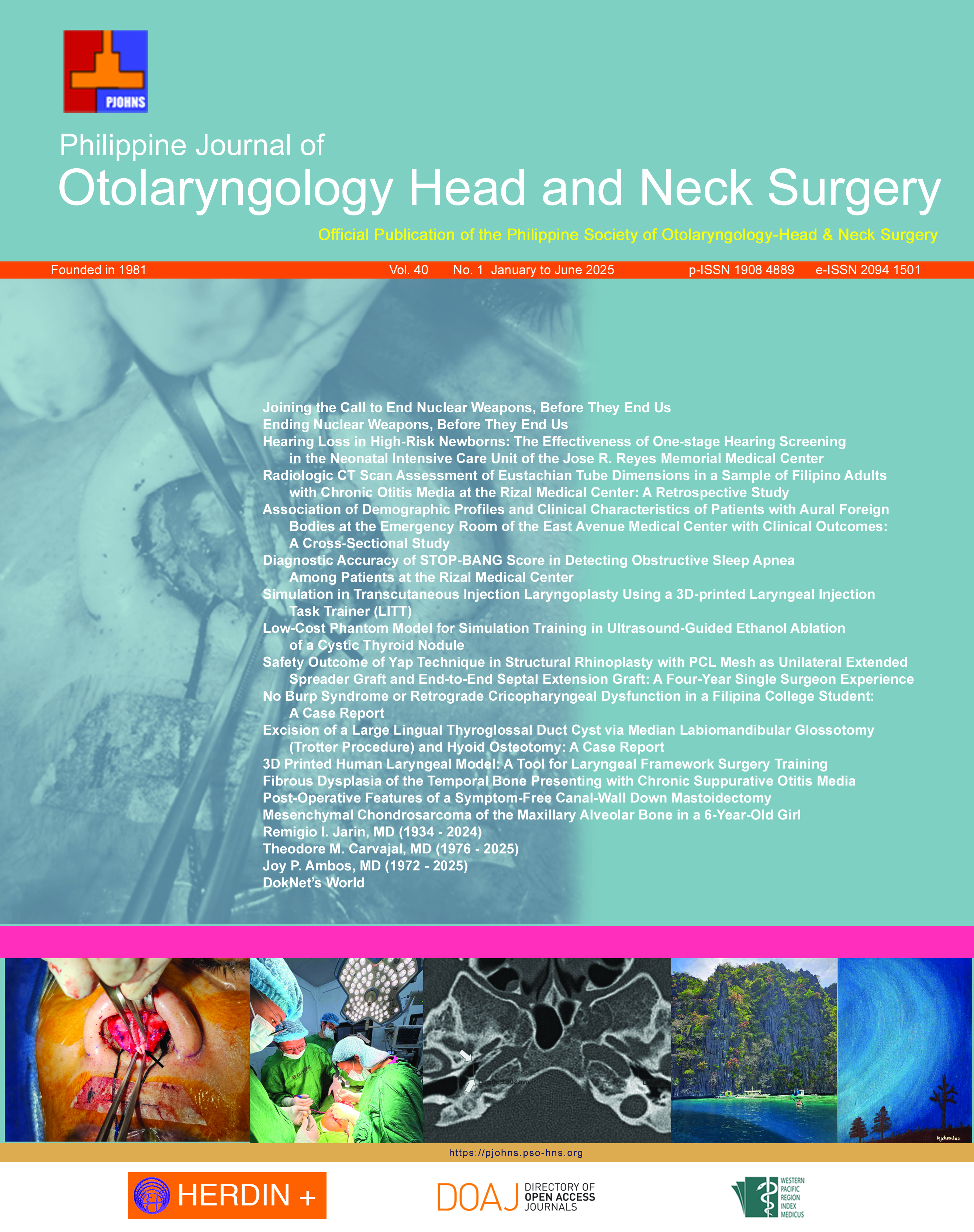
Hearing Loss in High-Risk Newborns: The Effectiveness of One-stage Hearing Screening in the Neonatal Intensive Care Unit of the Jose R. Reyes Memorial Medical Center
DOI:
https://doi.org/10.32412/pjohns.v40i1.2565Keywords:
newborn screening, evoked potentials, auditory, brain stem, otoacoustic emission, spontaneous, neonatal intensive careAbstract
Objective: To determine the effectiveness of a one-stage hearing screening protocol in detecting hearing loss in high risk newborns at the Neonatal Intensive Care Unit of the Jose R. Reyes Memorial Medical Center.
Methods:
Design: Cross-Sectional Study
Setting: Tertiary Government Training Hospital
Population: High-risk newborns admitted at the Neonatal Intensive Care Unit of the Jose R. Reyes Memorial Medical Center from March to December 2023 underwent a one stage universal newborn hearing screening protocol. Excluded from the study were patients who were admitted for less than 48 hours, without consent from their parents or guardians and babies who were not cleared medically to undergo testing, and those who presented with aural atresia and/or any physical anomaly of the head and the external ear.
Results: A total of 169 babies were initially seen with 16 babies lost to follow up resulting in a final total of 153 babies (or 306 ears) tested. The refer and false positive rates were 9.8% and 8.92%, respectively, on average comparable to or even better than the two-step protocol in most studies. Sensitivity was determined to be 100% while specificity was 91.08%. The incidence of hearing loss in the study population was 19.8/1000, consistent with various study outcomes for high risk newborns. There was no reported incidence of auditory neuropathy in this study. The primary risk factors that were present in babies with hearing loss were: low birth weight, prematurity, neonatal intensive care unit admission of more than 5 days and exposure to ototoxic medications.
Conclusion: The one-staged Automated Auditory Brainstem Response (AABR) is an effective and efficient newborn hearing screening protocol for high-risk newborns in the Neonatal Intensive Care Unit (NICU) setting and eventually, may be considered as an alternative hearing screening technique whenever available in this cohort. More studies about improving newborn hearing screening, cost-analysis, diagnostics and interventions of hearing loss should be pursued in implementation of the Universal Hearing Screening Law in the Philippines.
Downloads
Published
How to Cite
Issue
Section
License

This work is licensed under a Creative Commons Attribution-NonCommercial-NoDerivatives 4.0 International License.
Copyright transfer (all authors; where the work is not protected by a copyright act e.g. US federal employment at the time of manuscript preparation, and there is no copyright of which ownership can be transferred, a separate statement is hereby submitted by each concerned author). In consideration of the action taken by the Philippine Journal of Otolaryngology Head and Neck Surgery in reviewing and editing this manuscript, I hereby assign, transfer and convey all rights, title and interest in the work, including copyright ownership, to the Philippine Society of Otolaryngology Head and Neck Surgery, Inc. (PSOHNS) in the event that this work is published by the PSOHNS. In making this assignment of ownership, I understand that all accepted manuscripts become the permanent property of the PSOHNS and may not be published elsewhere without written permission from the PSOHNS unless shared under the terms of a Creative Commons Attribution-NonCommercial-NoDerivatives 4.0 International (CC BY-NC-ND 4.0) license.