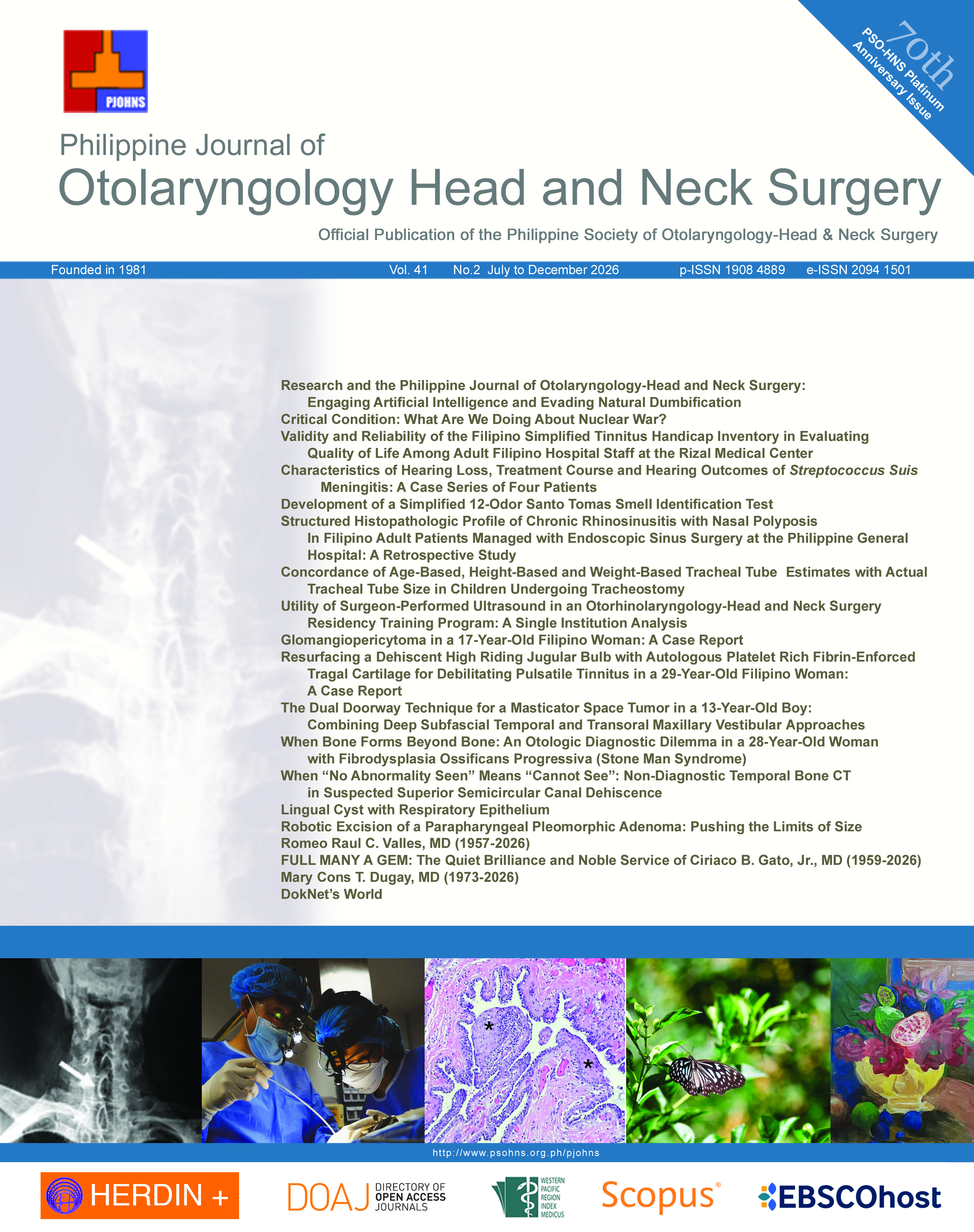
Development of a Simplified 12-Odor Santo Tomas Smell Identification Test
Keywords:
olfaction, smell, olfactory disorders, odorants, anosmia, cultural characteristicsAbstract
Objective: To develop a shorter, culturally relevant set of candidate odorants from the Santo Tomas Smell Identification Test (ST-SIT) for contemporary Filipino adults using odor familiarity, correct identification performance, and descriptive item-discrimination analysis, and to update its scoring framework.
Methods:
Design: Cross-Sectional Study
Setting: ORL-HNS Outpatient Clinics (private and clinical divisions)
in a Tertiary Private University Hospital
Participants: Patients aged ≥ 5 years, born and raised in the Philippines, with no
olfactory complaints seen at the University of Santo Tomas Hospital outpatient clinics were included. Those with altered consciousness, psychiatric illness, allergy to the underlying material where odorants are sourced, on oxygen supplementation, known olfactory dysfunction, nasal symptoms or treatments affecting smell (e.g., rhinitis, chronic rhinosinusitis, recent URTI), prior head and neck surgery or injury, history of radiotherapy or chemotherapy, and pregnancy were excluded. Primary item-retention analysis was restricted to adults aged ≥18 years; participants younger than 18 years were retained only for descriptive developmental analyses
Results: A total of 90 participants were included, 54 women and girls (60.00%) and 36 men and boys (40.00%) with a mean age of 38.28 (SD=19.65). Four participants were aged 5–11 years (4.44%), 10 were aged 12–17 years (11.11%), and 76 were adults aged ≥18 years (84.44%). Regardless of age group, the most familiar odors were orange (x ̅=6.76, SD=0.43), vinegar (x ̅=6.71, SD=0.64), onion (Allium cepa) (x ̅=6.47, SD=1.00), fish sauce (patis) (x ̅=6.44, SD=1.10), banana (x ̅=6.42, SD=1.05), garlic (Allium sativum) (x ̅=6.41, SD=0.92), chocolate (x ̅=6.38, SD=0.93), soy sauce (x ̅=6.36, SD=1.09), pineapple (x ̅=6.29, SD=0.93), and fermented shrimp paste (bagoong) (x ̅=6.27, SD=0.92). On the other hand, the least familiar odors were tea (x ̅=3.96, SD=1.20), povidone-iodine (x ̅=4.02, SD=1.24), hot sauce (x ̅=4.07, SD=1.14), mustard (x ̅=4.12, SD=1.36), vitamin C syrup (x ̅=4.36, SD=1.28), almond (x ̅=4.50, SD=1.42), laurel leaf (Laurus nobilis) (x ̅=4.58, SD=1.85), caramel (x ̅=4.94, SD=1.20), vanilla (x ̅=5.11, SD=1.73), and brandy (x ̅=5.14, SD=1.48). Among the most correctly identified odorants were garlic (n=85, 94.44%), fish sauce (patis) (n=85, 94.44%), orange (n=85, 94.44%), onion (n=83, 92.22%), and chocolate (n=83, 92.22%). The odors that were least correctly identified included almond (n=40, 44.44%), povidone-iodine solution (n=42, 46.67%), vitamin C syrup (n=44, 48.89%), tea (n=45, 50.00%), and sampaguita (Jasminum sambac) (n=45, 50.00%). In the adult analysis (participants aged ≥18 years), 13 odorants had a mean familiarity rating ≥6.0; 12 of these also had correct-identification rates ≥70% and formed the provisional candidate panel: orange, banana, pineapple, chocolate, vinegar, soy sauce, fish sauce (patis), apple, onion, pepper, fermented shrimp paste (bagoong), and garlic. Quartile-based discrimination indices among adults ranged from −0.125 to 0.250, with substantial ceiling effects for several highly familiar, frequently identified items.
Conclusion: The simplified 12-odor ST-SIT is a practical, culturally updated screening instrument based on the original 45-odor version. Adult-based screening identified a culturally relevant 12-odor candidate set for further ST-SIT refinement. A simple equal-weight raw score (0 – 12) is proposed for subsequent validation, but currently no diagnostic cut-off has been established. Because item discrimination was limited by ceiling effects in this asymptomatic cohort and no clinically confirmed olfactory dysfunction group or external reference test was included, the candidate panel should not yet be considered a finalized or diagnostic instrument. Prospective validation, test–retest and inter-administrator reliability assessment, perceptual-intensity standardization, and diagnostic-accuracy testing are required before clinical cutoffs or routine diagnostic use are proposed
Downloads
Downloads
Published
How to Cite
Issue
Section
License
Copyright (c) 2026 Publisher

This work is licensed under a Creative Commons Attribution-NonCommercial-NoDerivatives 4.0 International License.
Copyright transfer (all authors; where the work is not protected by a copyright act e.g. US federal employment at the time of manuscript preparation, and there is no copyright of which ownership can be transferred, a separate statement is hereby submitted by each concerned author). In consideration of the action taken by the Philippine Journal of Otolaryngology Head and Neck Surgery in reviewing and editing this manuscript, I hereby assign, transfer and convey all rights, title and interest in the work, including copyright ownership, to the Philippine Society of Otolaryngology Head and Neck Surgery, Inc. (PSOHNS) in the event that this work is published by the PSOHNS. In making this assignment of ownership, I understand that all accepted manuscripts become the permanent property of the PSOHNS and may not be published elsewhere without written permission from the PSOHNS unless shared under the terms of a Creative Commons Attribution-NonCommercial-NoDerivatives 4.0 International (CC BY-NC-ND 4.0) license.